
What would you like to do at the end of a long, exhausting week? For me, I long for a stroll in the forest, breathing in lots of fresh air to recharge my mind. Satisfying this longing could be a luxury in a few years,
however. Forests, our Earth’s green lungs, are disappearing at an alarming rate. In California, the coast redwood - the tallest and largest tree in the world - are losing their habitat. Human land uses have been depleting redwood forests. Moreover, climate change has exacerbated deforestation, leaving this species more vulnerable than ever.
Is there hope of saving the redwoods, which capture more carbon dioxide (CO2) than any other tree on Earth? The gutsy community leaders in Mendocino County turned this far-fetched mission into a non-profit organization. The loggers, mill-owners, environmentalists, and financiers there worked together to start Redwood Forest Foundation Inc. (RFFI) in 1997. Today, they have created community-based forests for all of their citizens and become a pride of California! Here are five things you should know about this grassroot organization:
RFFI has restored the 50,000-acre Usal Redwood Forest.

In 2007, RFFI made a loan purchase of Usal Redwood Forest in the coastal area of Mendocino County. Almost twice the size of San Francisco, Usal Redwood Forest had been damaged by aggressive timber harvesting. With the support of community partners, RFFI invested $5 million to restore Usal’s two major watersheds: Usal Creek and South Fork Eel River Watersheds. They contain some of the most important spawning streams for salmon and trout!
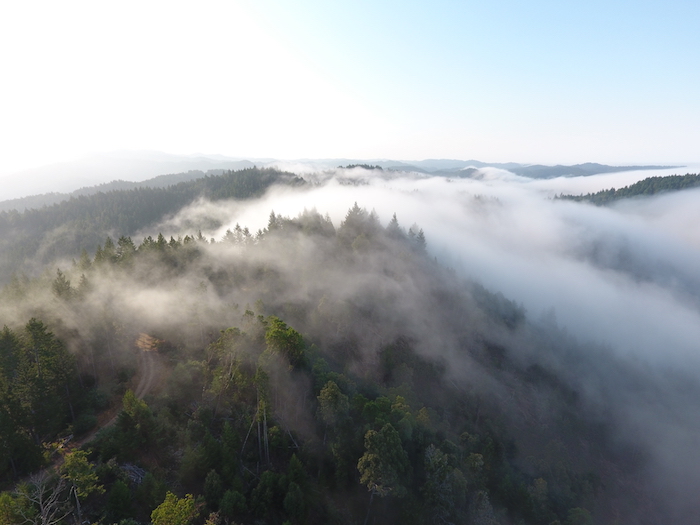
The Usal Redwood Forest in Mendocino County (source: https://adventuresportsjournal.com/riding-the-lost-coast/)
Take Anderson Creek in South Fork Eel River watershed for example. In the 1970s, the Usal Forest used to be logged heavily. The huge log jam at the confluence of Anderson and Indian Creeks became a fish barrier for decades. Thanks to RFFI’s forest and watershed restoration, a pair of threatened Coho salmon were seen spawning in the creek again!
 RFFI has planted over 135,000 redwood trees since 2010.
A 2019 study published in Science emphasizes the role of tree restoration in climate change mitigation. The research team estimated that planting more than a half trillion trees could capture about 205 gigatons (billion metric tons) of carbon, reducing atmospheric carbon by 25%. In the past decade, RFFI has saved thousands of baby redwoods from destruction and planted over 135,000 redwoods through their reforestation program. Inspired by many young philanthropists who care about the redwoods, I donated to RFFI for the first time this year to plant 10 redwood trees. My donation is just a drop in the ocean, but I thank myself for taking action on climate change. I invite you also to consider giving $50 or $100 to plant a group of young redwoods!

Every donor receives a certificate with their name and personalized message.
It manages California’s largest forest carbon sequestration project.

Greenhouse gases that come from our transportation, electricity use, and industry trap heat in the atmosphere, causing global warming. The IPCC in Switzerland warned that our earth will be in deep water if world leaders don’t take action to limit global warming to 1.5C. So, what can we do to remove Carbon Dioxide (called Carbon Sequestration), getting our earth out of the woods?

As you might have guessed, a good answer is redwood forests! Do you know that RFFI manages the largest forest carbon sequestration projects in California? It received the Carbon Offset Project Developer Award from Climate Action Reserve in 2016. As Mark Welther, RFFI CEO and President said, “Usal, a working community forest, with 3,166,372 credits issued in 2015, has one of the largest improved forest management carbon projects in the country.”

Mark Welther (left), CEO and President of RFFI receiving award from the Climate Action Reserve in 2015.
 RFFI has pioneered a model of “working community forests”.
As a rural community, RFFI understands how human activities depend on forest ecosystems. For this reason they moved into uncharted waters to start a model for sustainable forest management. Their model has three parts: restoration, logging, and tourism. It is unique in these ways:
- Use private equity to invest in conservation
- Purchase and conserve large forest land
- Involve communities in forest management
- Repay community with net profit from sustainable harvest
RFFI’s approach has not only improved the forest ecosystem, but strengthened their community. They are now moving heaven and earth to guide the forest management movement around the country. More than that, their model could be a silver lining for zoonotic viruses like COVID-19.

 Its climate action was featured in the Leonardo DiCaprio Documentary, “ICE ON FIRE”.
“Science tells us that our current climate crisis is a problem we’ve created, but it is also a problem that we can fix.” DeCaprio says in the film’s press notes. “Ice on Fire” reminds us that the wildfires we’re experiencing is not the final straw. There’s a lot we can do to stop climate change, right now.
Ice on Fire (2019): Official Trailer
The very interesting post! It is very relevant now that a fairly large part of California is suffering from wildfires.
ReplyDeleteThanks Andrei! Hope you get a chance to visit the Usal Redwood Forest. It looks beautiful on the pictures!
DeleteThis comment has been removed by the author.
ReplyDelete